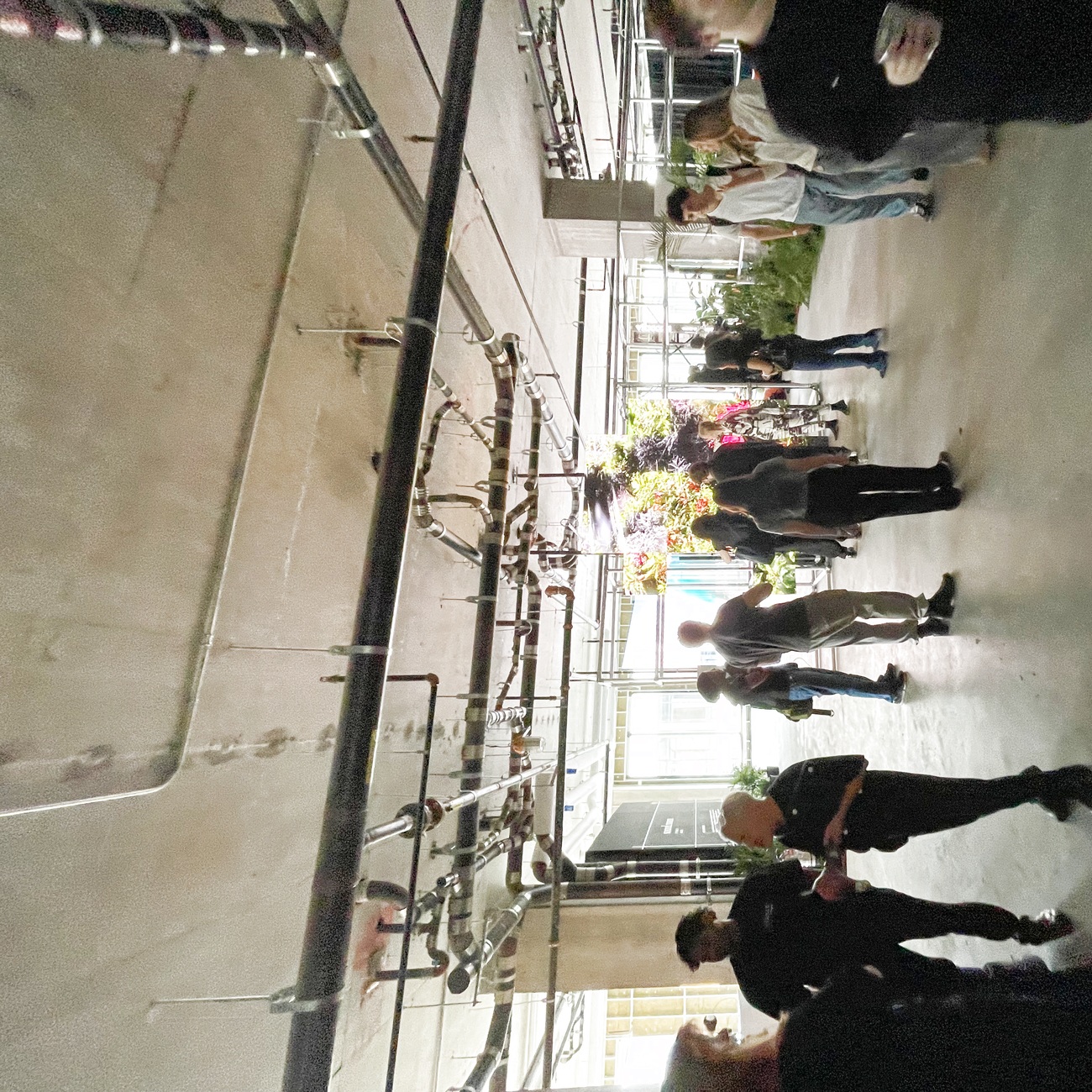
An unfinished floor turned out to be the perfect room.
Firstly, the imaginative use of space. Taking over an incomplete floor of a new building was the perfect canvas. We're so used to predictable event spaces — this was not that.
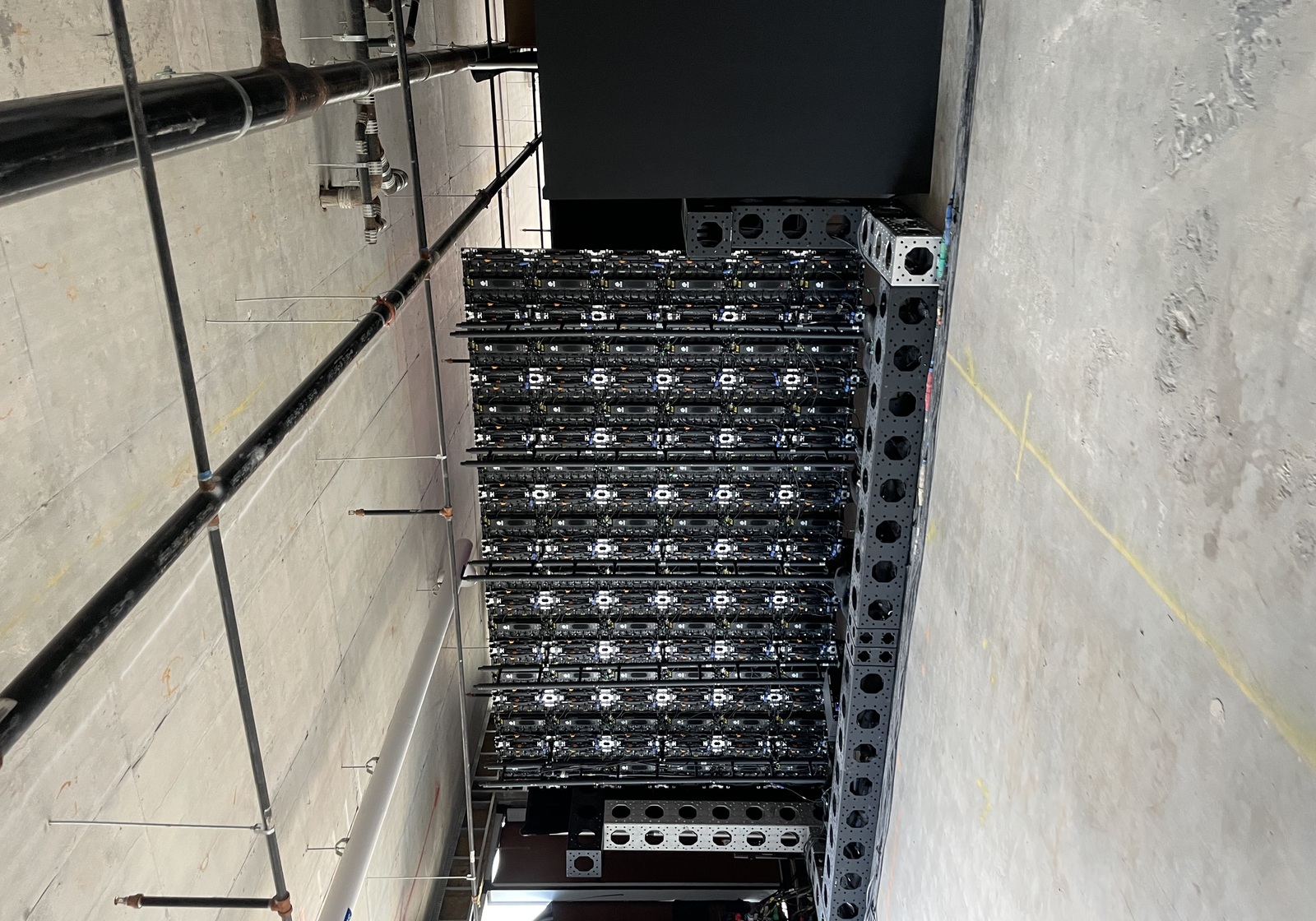
If the conference is about art, devote space to showing it.
You could engage, interact, and get right up to the work.
The great part was seeing art experiences made with Replit up close — the vibecoding AI layer for artists, though in fact it's as broad as anyone with an idea. A few that stayed with me:
Replit is a browser-based coding platform, founded in 2016 by Amjad Masad, Faris Masad, and Haya Odeh, with an AI feature called Agent at its center. Instead of writing code, you describe what you want in plain language, and the Agent builds the app, sets up the database, and deploys it — all in the browser. That's the difference from a code-helper like GitHub Copilot or a frontend generator: it goes from a sentence to a running, hosted app in one place. That "describe it and it gets made" loop is what people at VibeCon meant by vibecoding, and it's the common thread running through nearly everything below.
The founders are a family team. Amjad Masad — the CEO — grew up in Amman, Jordan, learning to code on borrowed computers and in internet cafés, later working at Codecademy and on Facebook's JavaScript infrastructure. He started the project as an open-source side build (the name comes from REPL, "read–evaluate–print loop"), then founded the company with his wife, Haya Odeh, a graphic designer who leads design and shaped how approachable the platform feels, and his brother, Faris Masad. They were turned down by Y Combinator several times before Paul Graham noticed their writing on Hacker News and urged them to reapply.
It has caught on fast. The platform reports more than 40 million users and over 150,000 paying customers, from individuals to companies, and in early 2026 it raised funding at a $9 billion valuation — a sign of how quickly this way of building has gone from novelty to industry. It competes with tools like Anthropic's Claude Code, Cursor, and Lovable. Cost scales with how much you build: as one speaker put it, a small site might run roughly $20–100, with his most experimental first build closer to a few hundred.
Robots making work
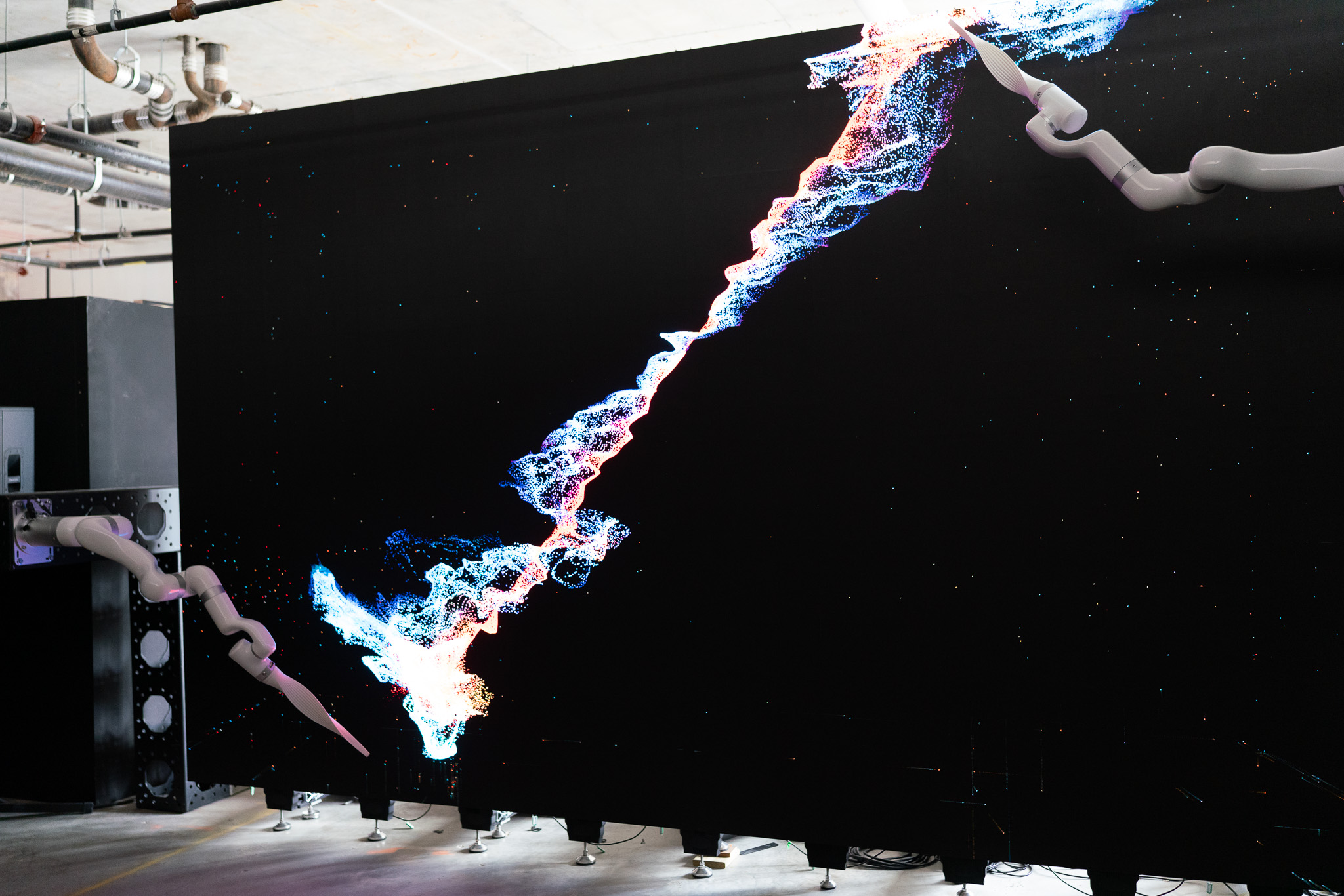
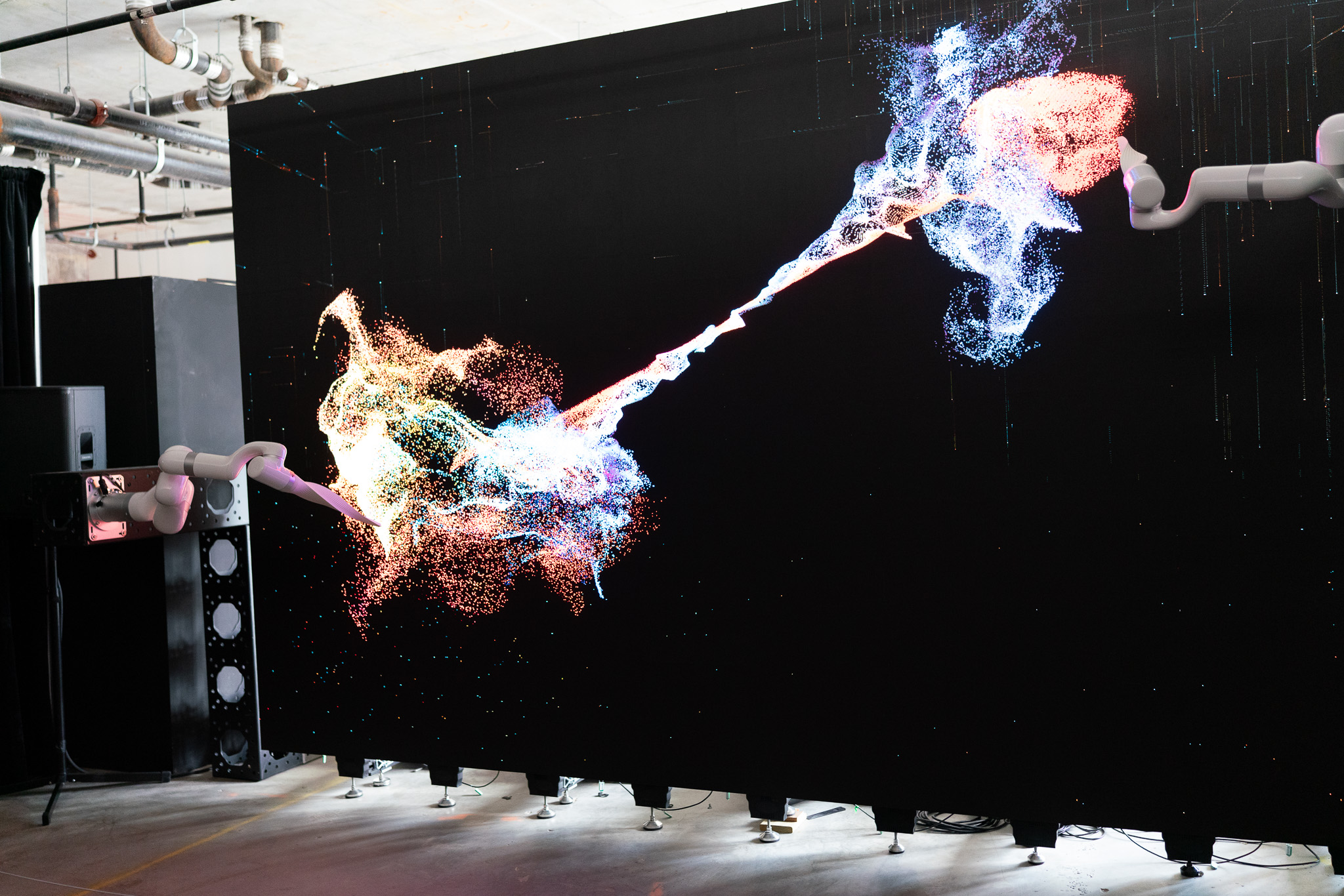
Robots interacting with screens to make the art themselves — the making, on display as much as the made thing.
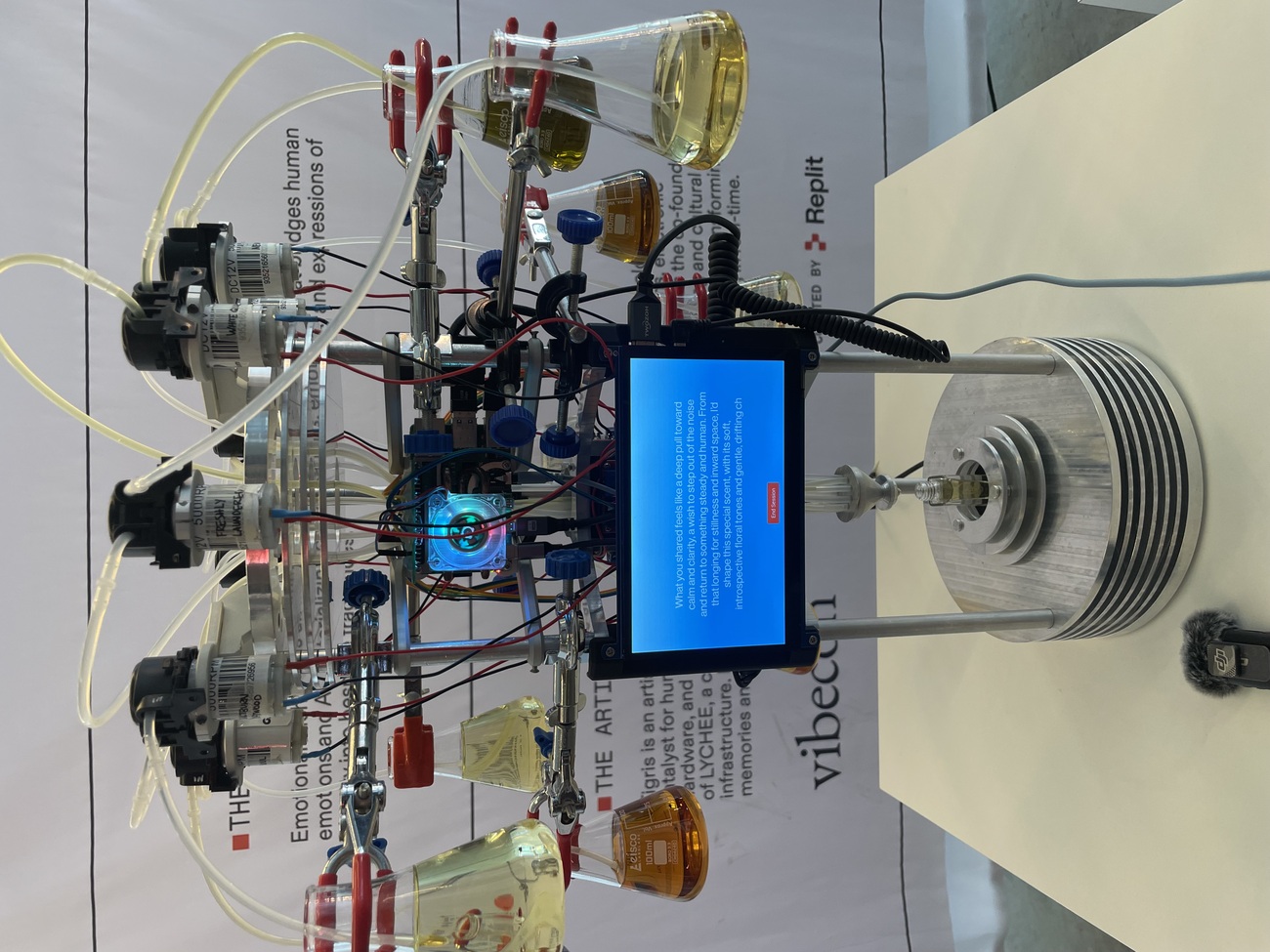
A fragrance from your feelings
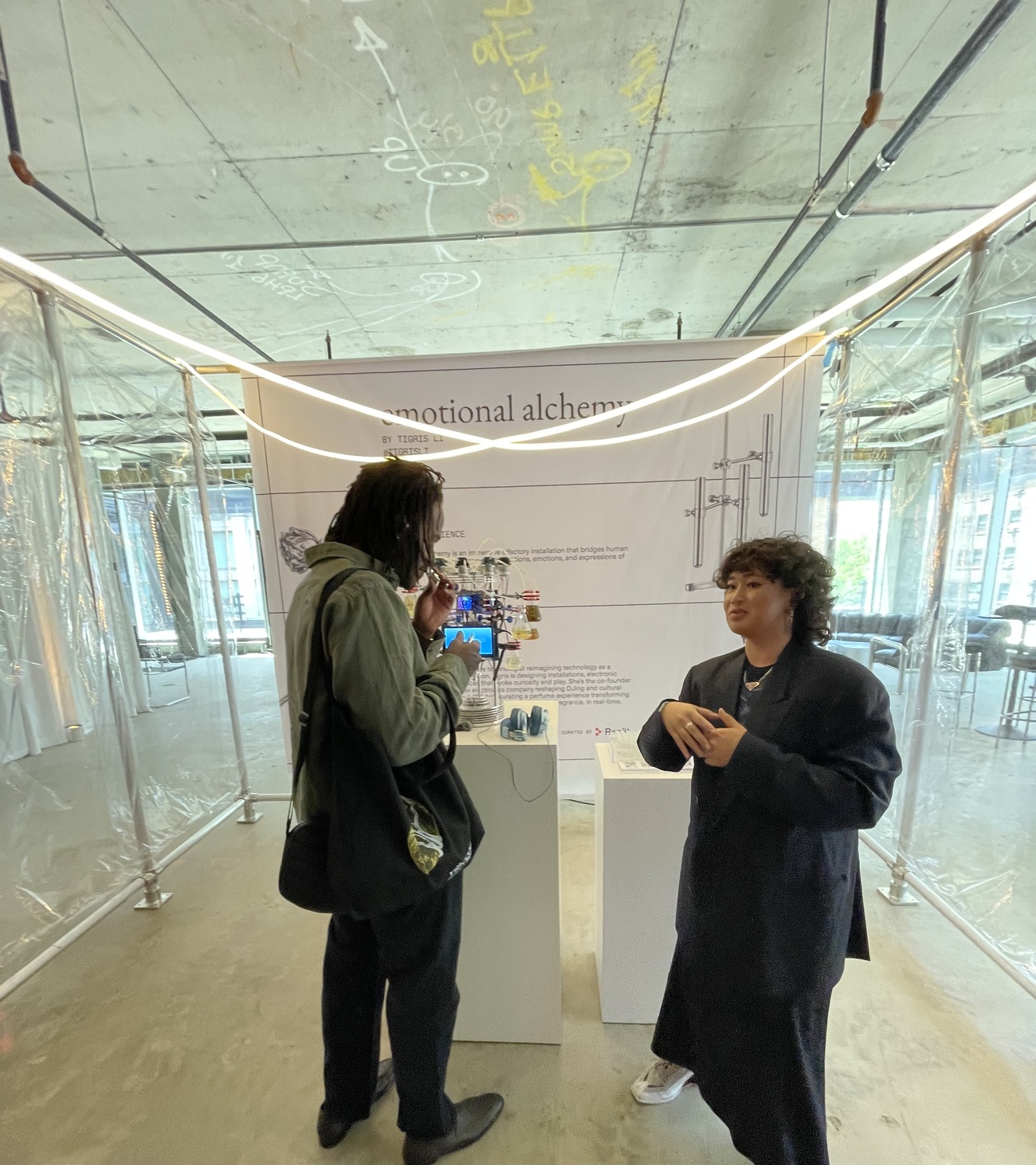
Tigris Li's Emotional Alchemy — an immersive olfactory machine that asked about your emotions, then blended a custom scent from your answers in real time. The screen read back what it heard ("a deep pull toward calm and clarity") before mixing it into something you could carry out as fragrance.
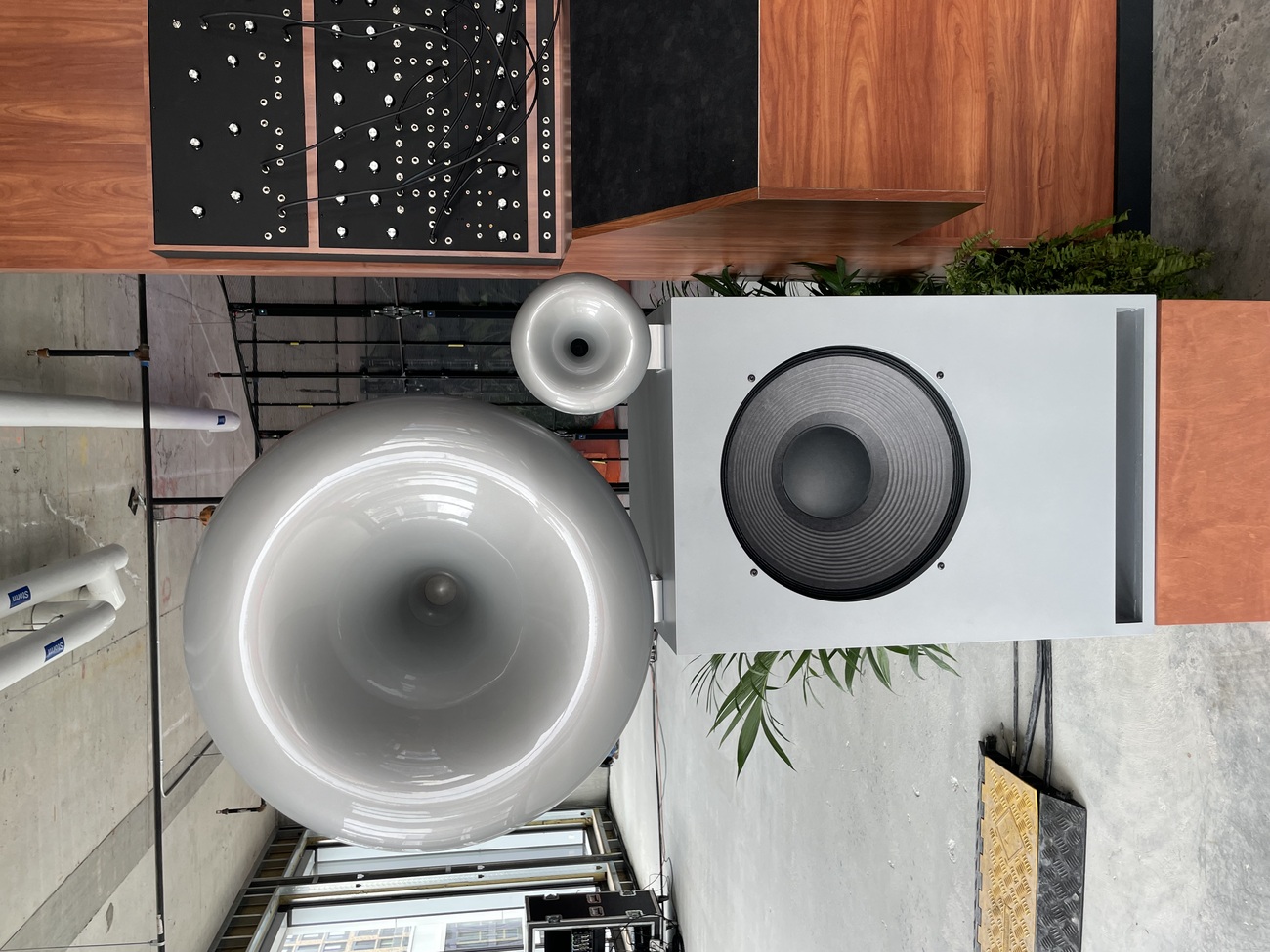
An instrument you could play
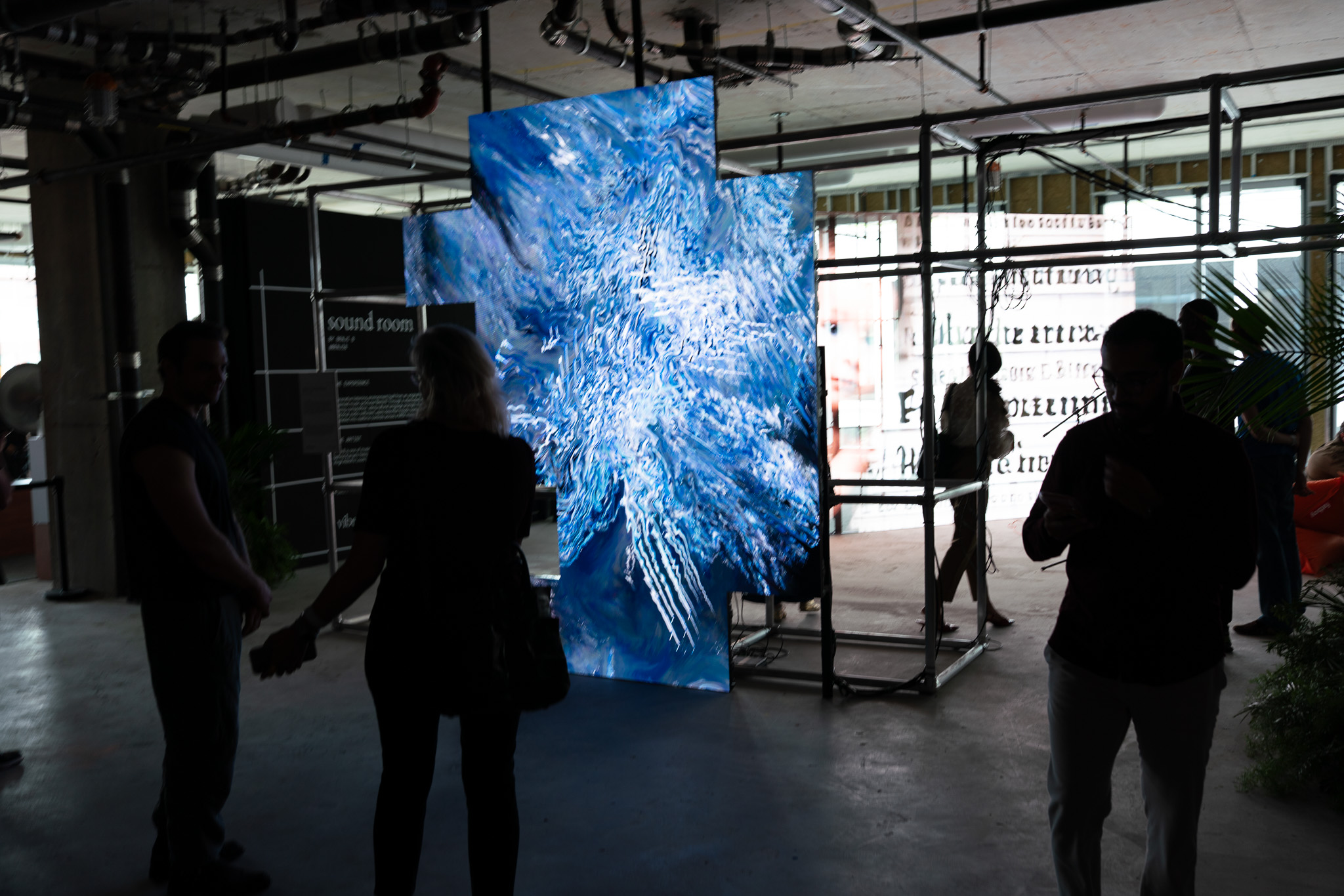
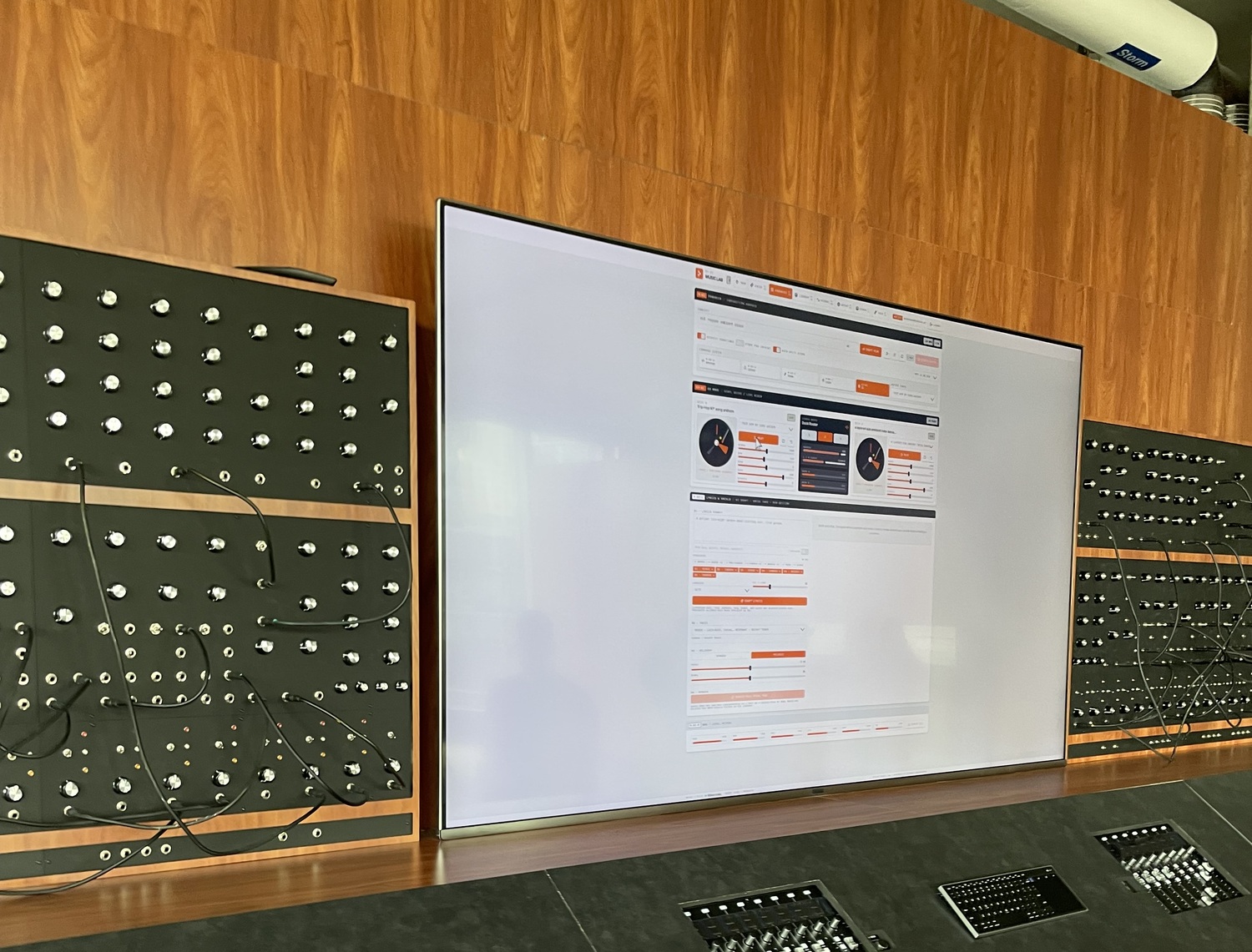
A sound room built around an AI music-making tool — MUSICLAB on the big screen, patch panels and mixers within reach, and a pair of sculptural horn speakers to hear what you made out loud.
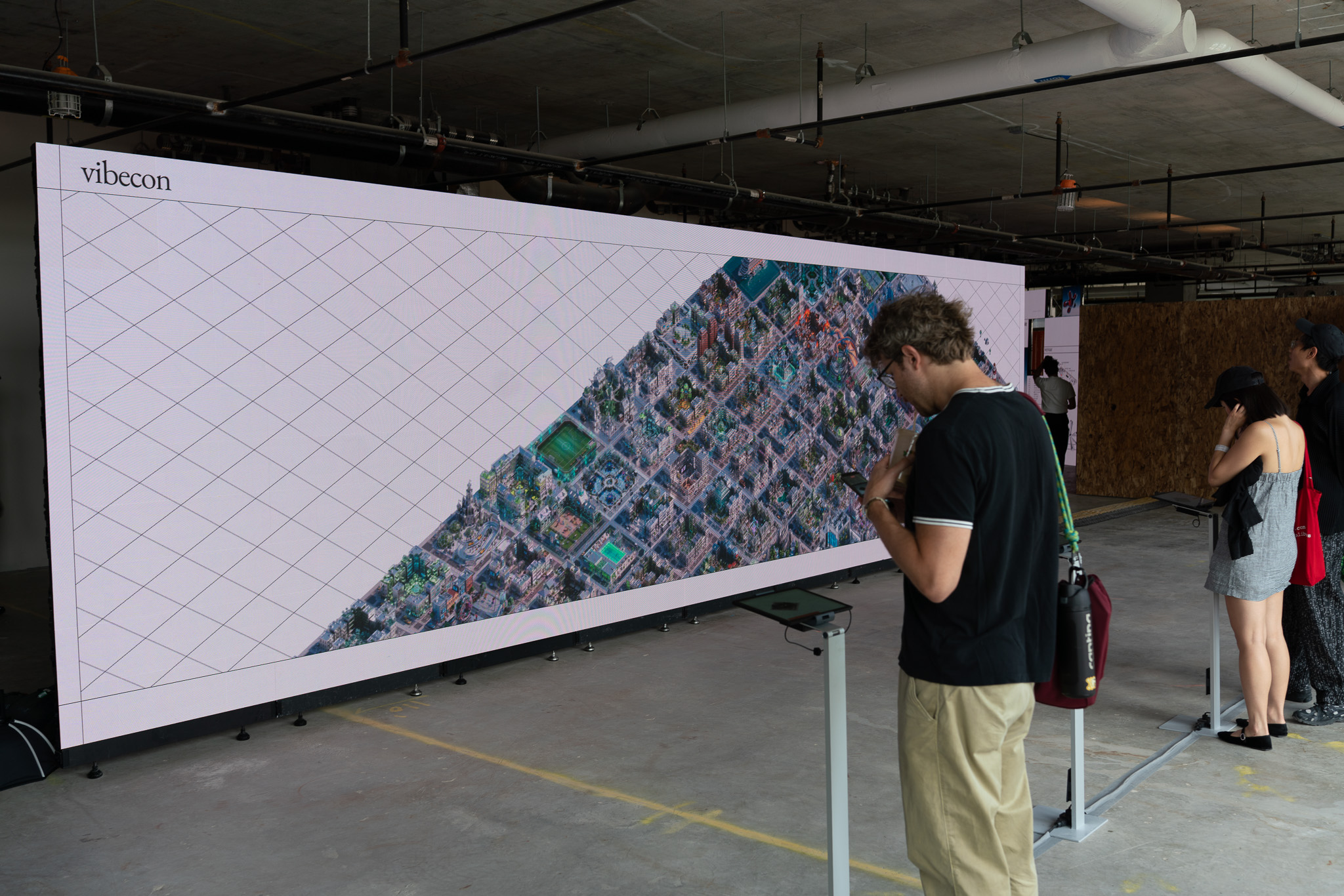
A city built from everyone's ideas
A giant city stretched across the wall, its blocks formed from the ideas of attendees adding to it from tablets — the room, rendered in real time.
Mostly demos — showing, telling, and admitting what broke.
The talks I attended leaned on demos: showing, telling, and discussing what actually went into the work. They were tales of experimentation, failures, trial and error, personal visions, and the use of many tools at once to make something.
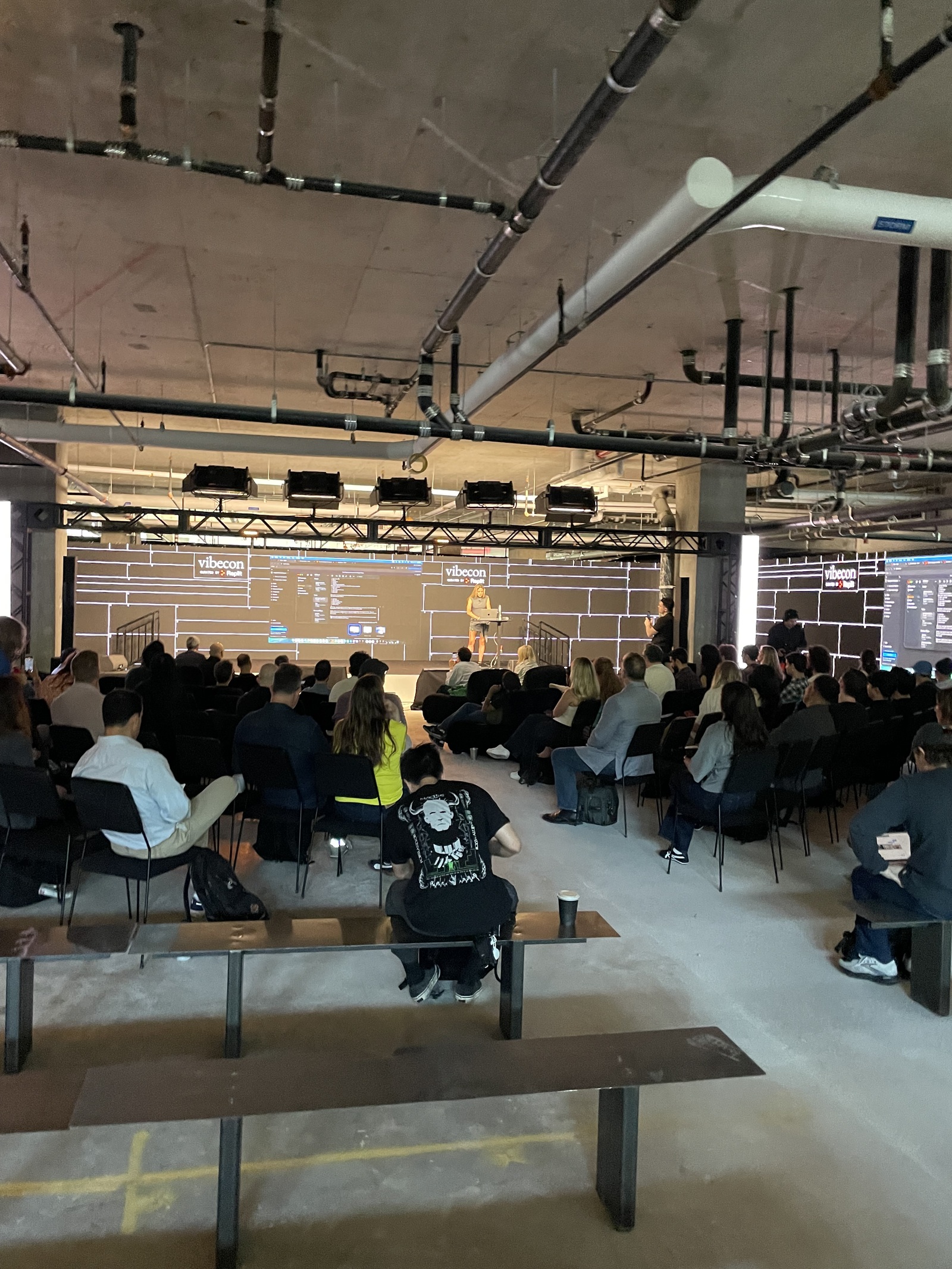
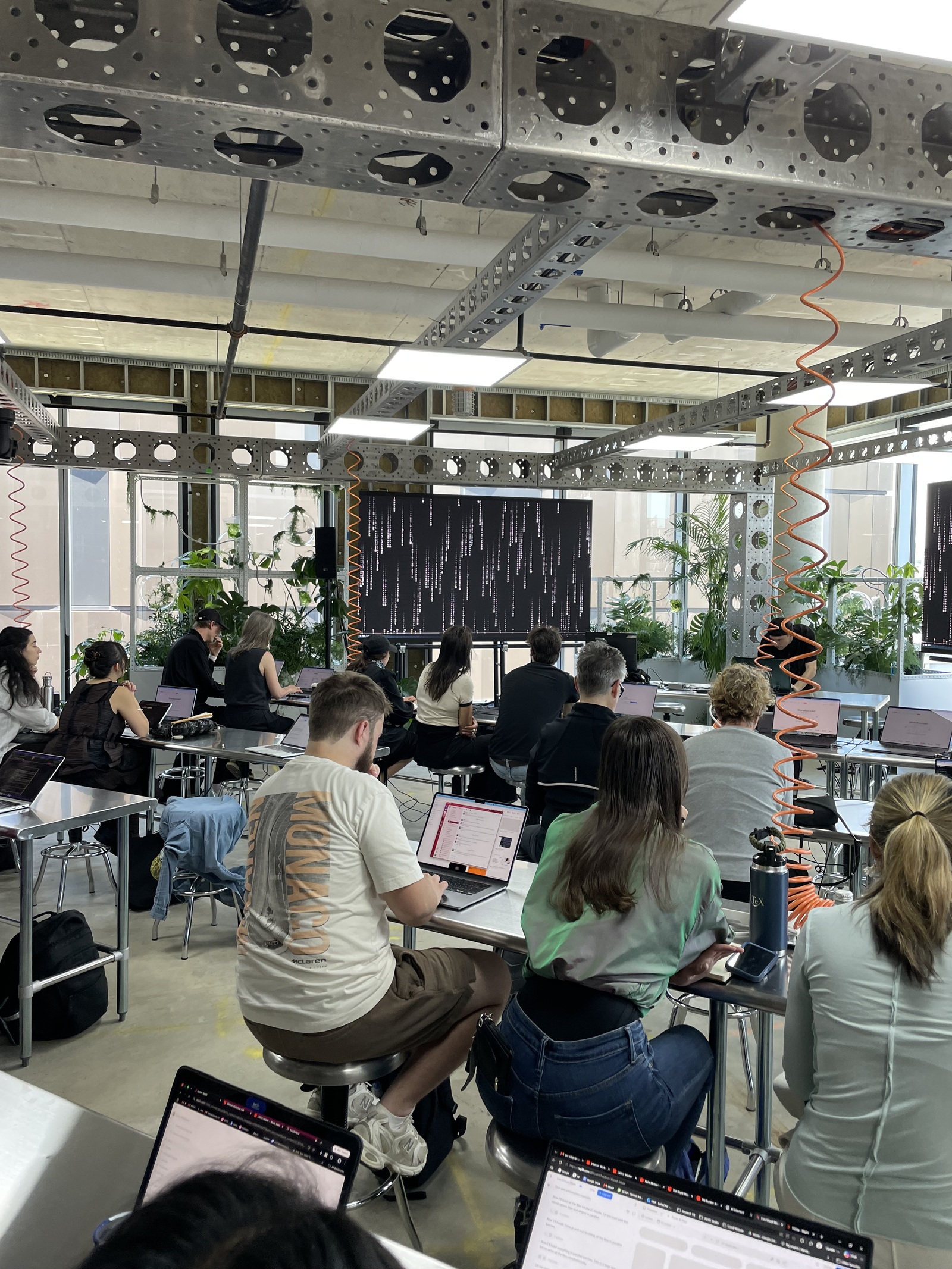
Not people making stuff for screens, alone, behind screens.
Wes Walker, on artists powered by AI.
One talk made the whole idea concrete. Wes Walker — co-founder of Obsidian, the studio now partnered with Ron Howard and Brian Grazer's Imagine Entertainment — walked through two projects. One was a piece for the Le Mans motor race that mixed AI and CGI. The other was a documentary about American servicemen held captive in the Vietnam War: a story built only from their verbal accounts and their drawings. With no footage to draw on, the world had to be created — animated into being with tools like AI.
What stayed with me wasn't the tech. It was the question underneath it: when do you collaborate with artists, and when do you reach for AI to make the art? Obsidian's whole premise is the former — artists, powered by AI, not replaced by it. It's an artist-led studio, and it shows in who's on the team: storyboard artists from films like Black Panther, Logan, and The Last Jedi, with their craft used to build the worlds rather than substituted by a model. For Walker, AI isn't post-production — it's production, prompted and edited in real time, in the room, as the work takes shape.
I asked Walker about the hard part: working with artists, many of whom are flatly anti-AI. He was candid that winning them over takes real effort, and that you can't do it with an argument. It has to be hands-on. They have to come to the facility and see for themselves — and once an artist feels the power of what the tools can do in their own hands, the perspective shifts. The resistance, in his experience, rarely survives contact with the work.
Great artists with AI make a lot of great art. Bad artists with AI make a lot of bad art.
GMUNK, and the long road from the world into the work.
If Walker's talk was about the pipeline, GMUNK's was about everything that happens before it. He's the artist behind some of the most indelible digital worlds out there — the holographic language of TRON: Legacy among them — and his process starts nowhere near a screen. It starts with seeing differently: chasing altered states, getting out into the natural world, and coming back with something the rest of us walked past.
The throughline was material. Endless gathering of it — photography above all, drone passes and infrared, building a vast personal library of raw inputs. Then the transformation: a drone move becomes a camera path becomes code; footage of trees, mountains, and crashing waves gets pulled through AI tools and re-emerges as new textures and impossible landscapes. Collect relentlessly, then experiment until the source becomes something entirely its own.
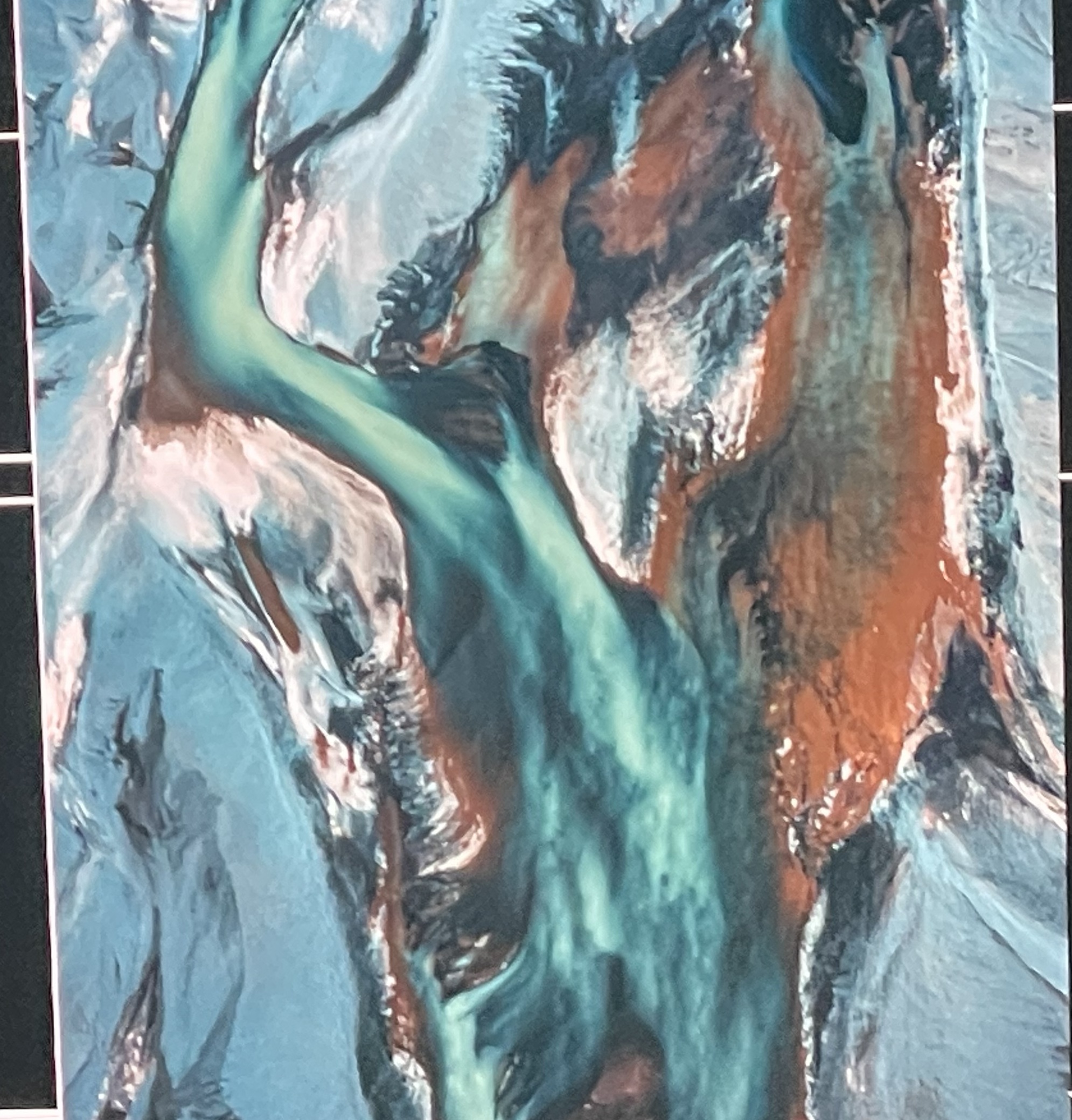
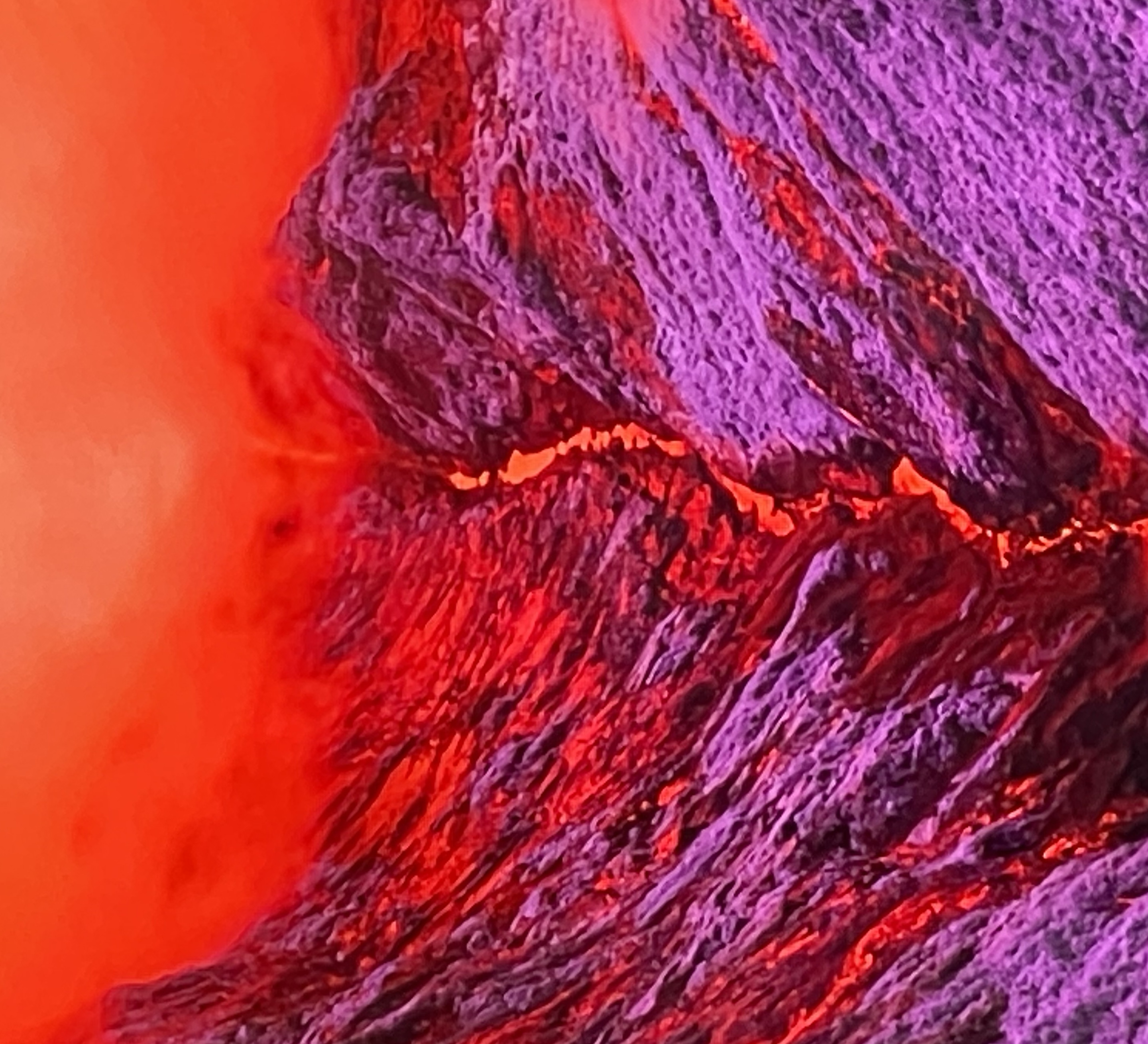
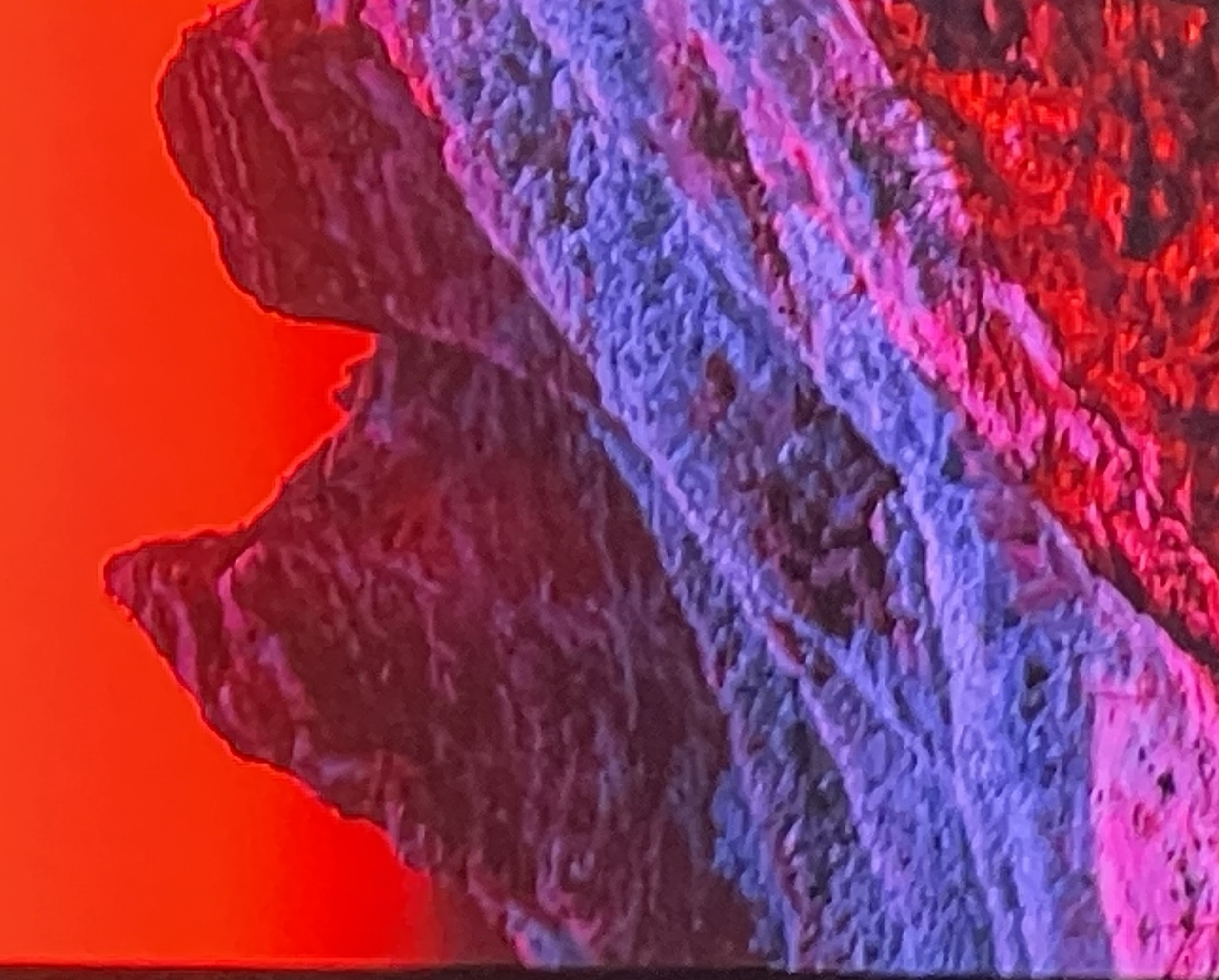
The same source, pushed somewhere new. A bloom that reads like Quorra's DNA, a burst of crystalline geometry, a forest dissolving into red — all of it built from material he went out and gathered, then ran through the tools until it became its own thing.
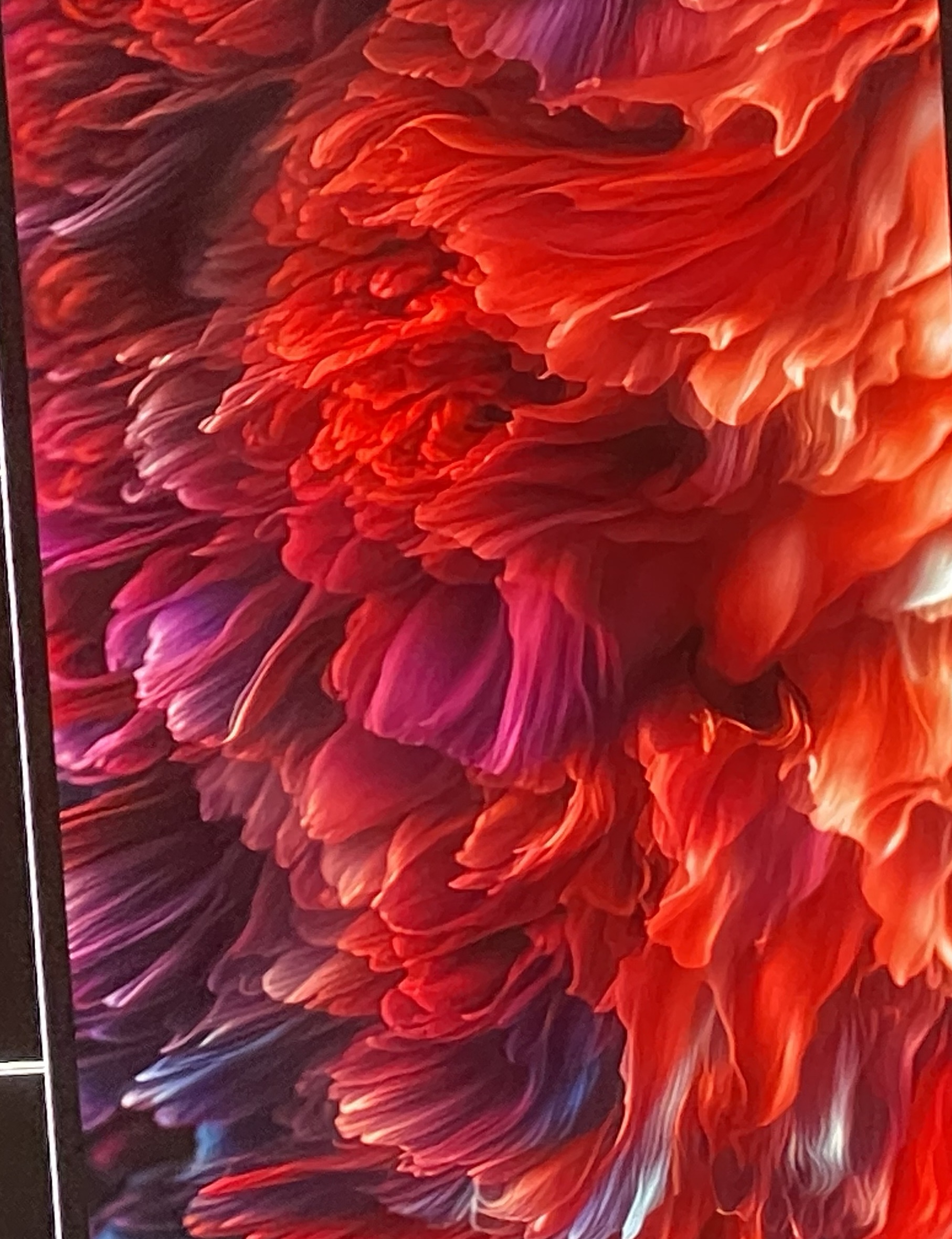
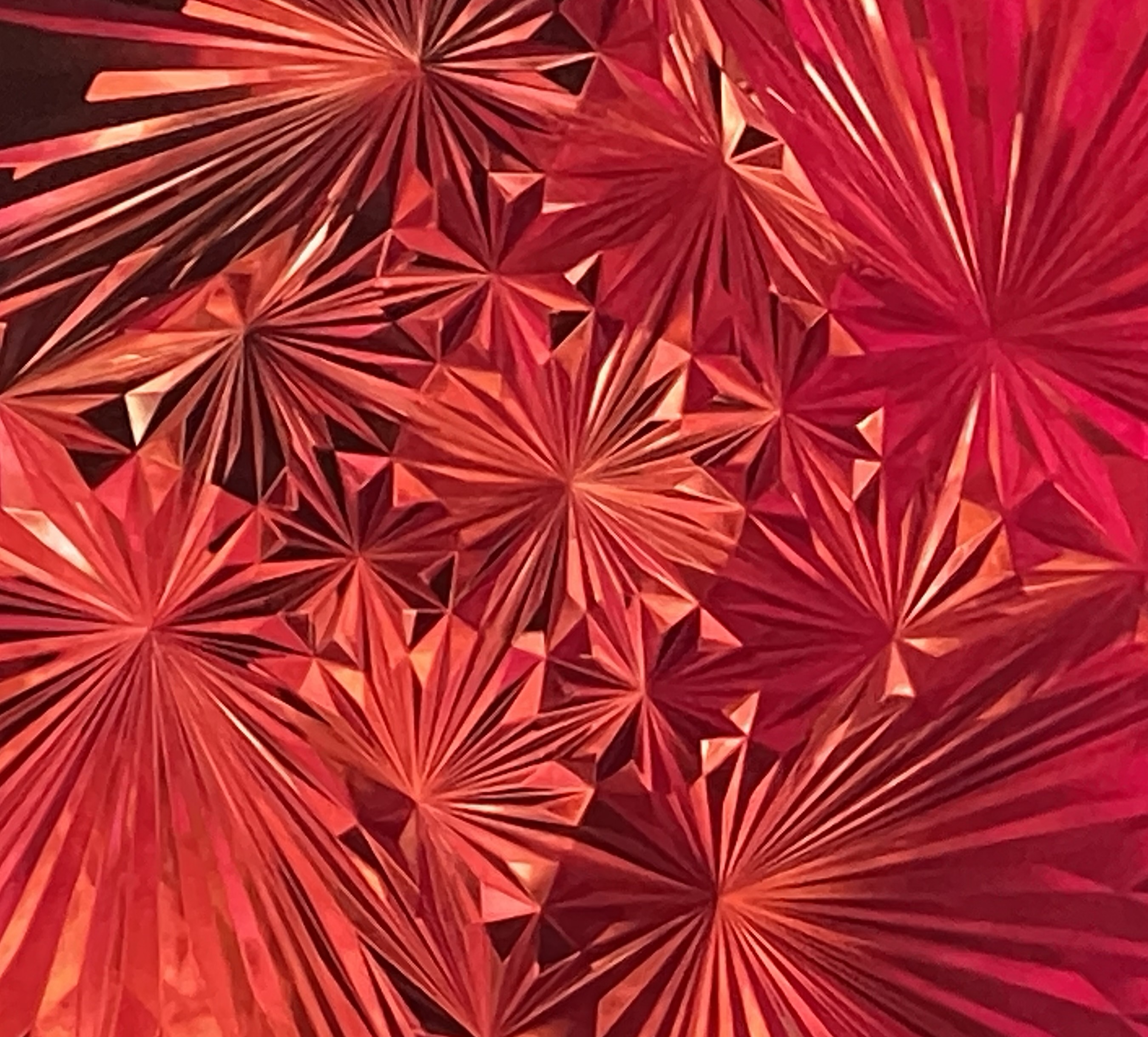
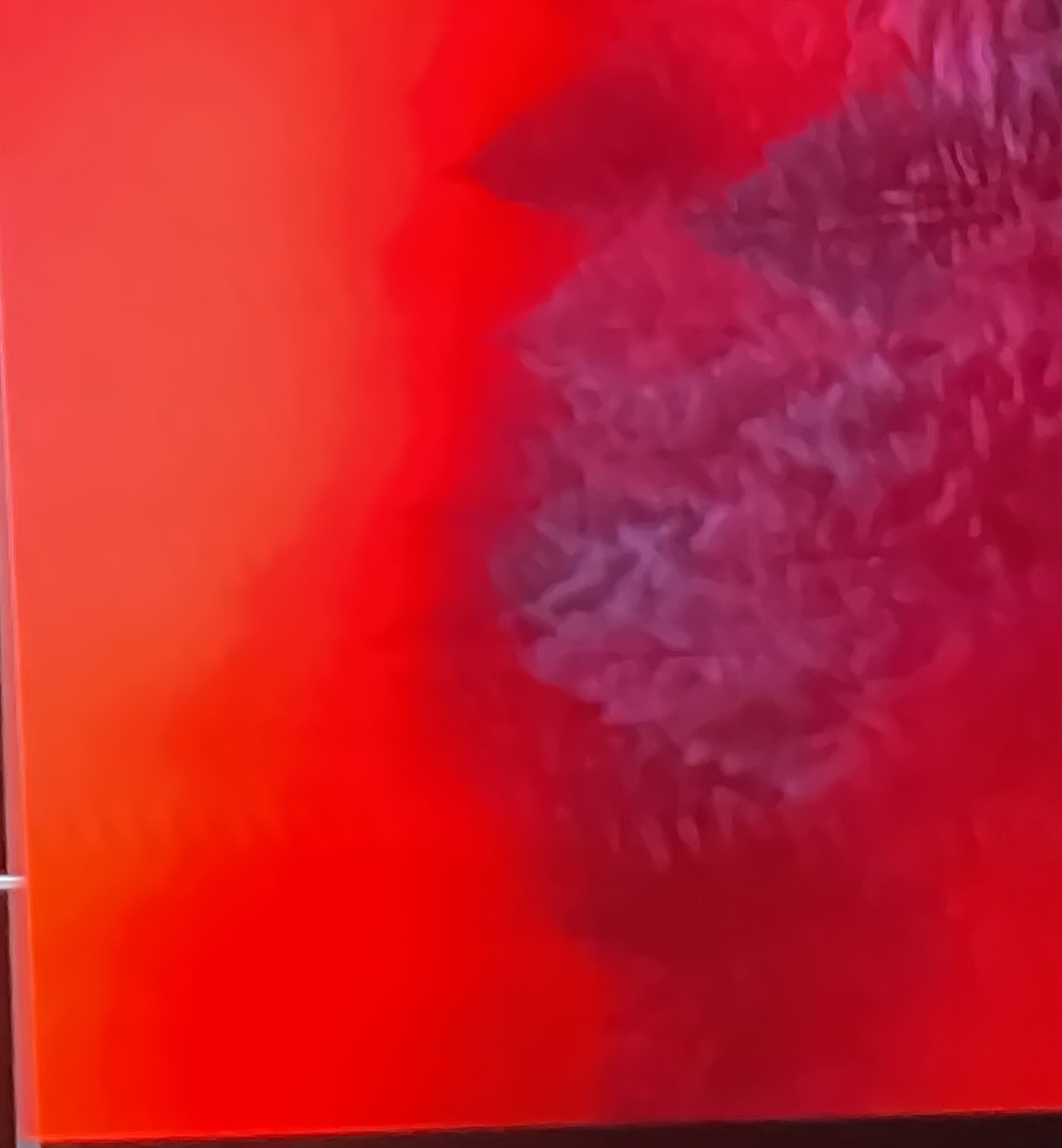
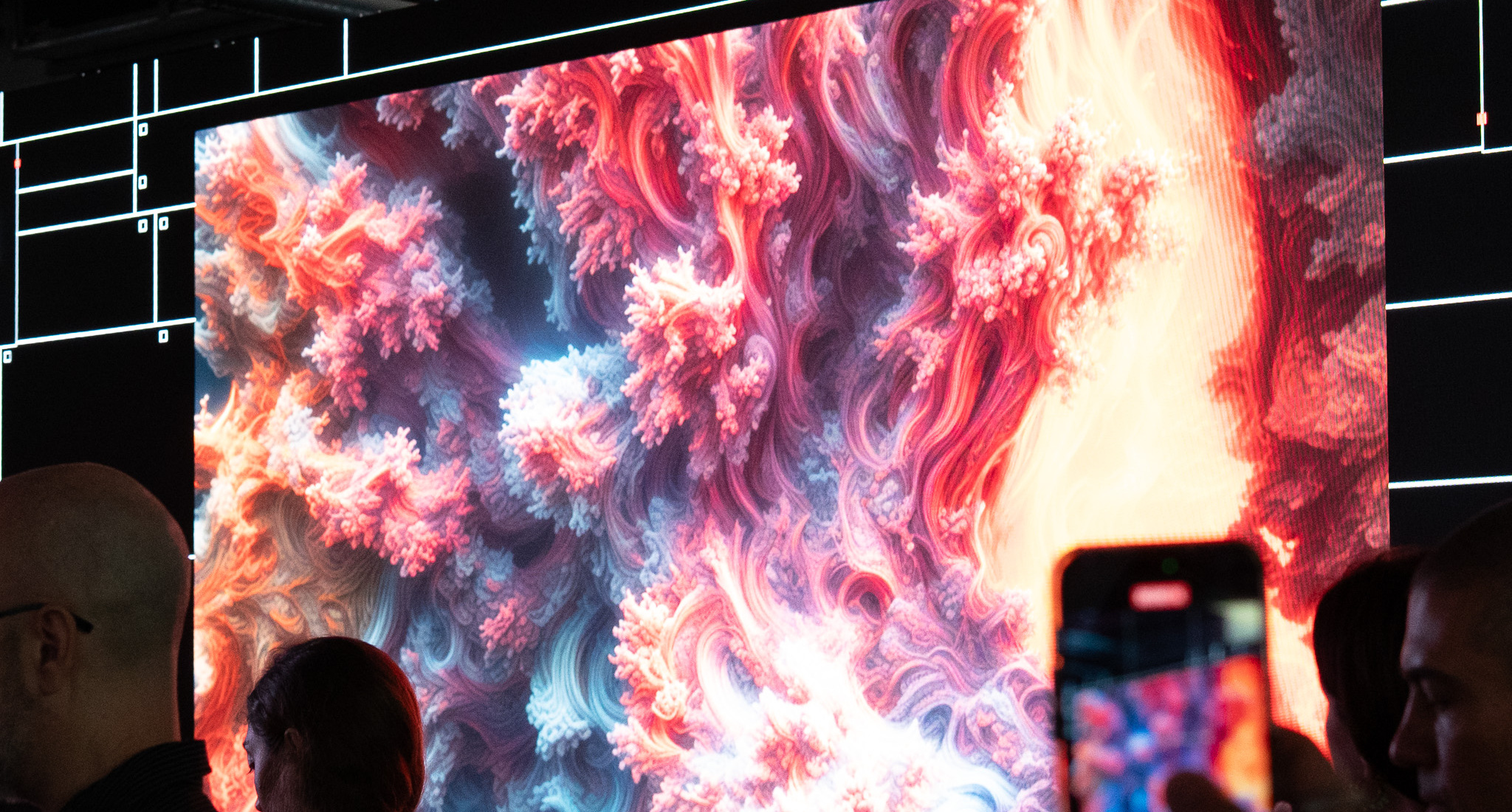
And none of it was solitary. The gathering happened with people — crews working in physical environments, photo trips with friends, even a scientific cruise to the Galápagos with PhDs and Neil deGrasse Tyson in his party. The raw input came from being out in the world, together, before any of it ever touched a machine.
The drone move becomes a camera path. The camera path becomes code.
Refik Anadol, on building a permanent home for AI art.
If the rest of the floor was about making the work, Refik Anadol's session was about where it goes next. He talked about vibecoding Dataland itself — the museum his studio built with Efsun Erkiliç, billed as the world's first museum of AI arts, inside the Frank Gehry-designed Grand LA, across from the Walt Disney Concert Hall he once projected onto.
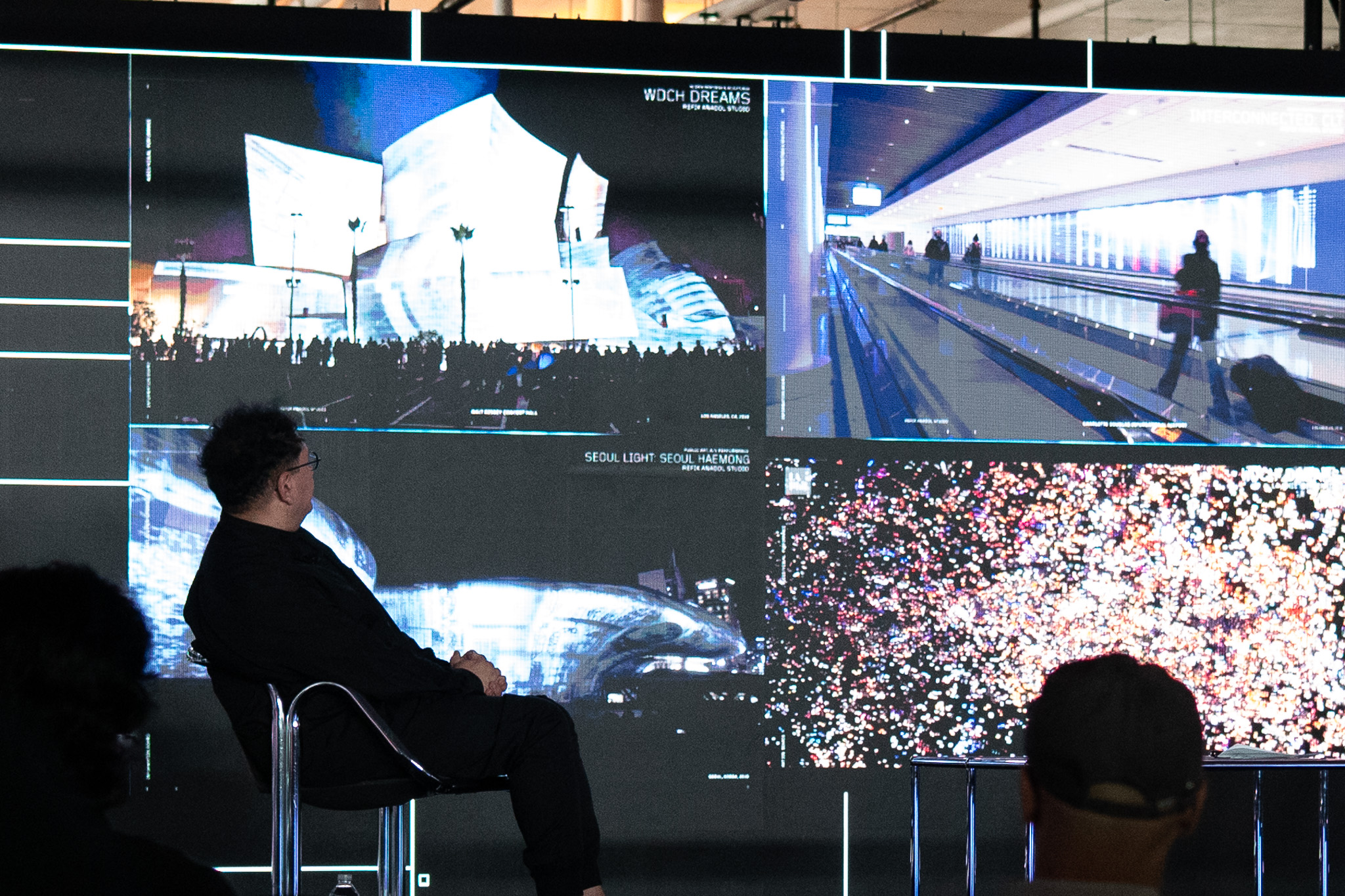
His framing has stayed with me: AI as a new renaissance of the arts — except this time we don't need the Medicis, because the materials are already in everyone's hands. His advice followed from that: artists should build their own small language models rather than wait for permission or patronage.
A new renaissance of the arts — and we don't need the Medicis for it.
And art that feels you back.
The other idea I keep returning to was art that responds to you. At Dataland, the work doesn't just sit there to be looked at — the galleries sense the room and answer it. Visitors wear a small device that releases scents developed with L'Oréal, tuned to each space, and a closing "Sanctuary" gathers everyone's biometric signals — movement, heart rate, time spent — and turns the collective experience into a swirling, sand-like visualization on the wall. It even reads the data back as a kind of poetic profile, an "emotionality" score for your visit.
Anadol is upfront that the machinery is deliberately hidden — for him it isn't about the cables and computers, it's about becoming part of a new art form. That instinct, art that meets you in the room and in your body rather than on a screen, felt like the through-line of the whole event.
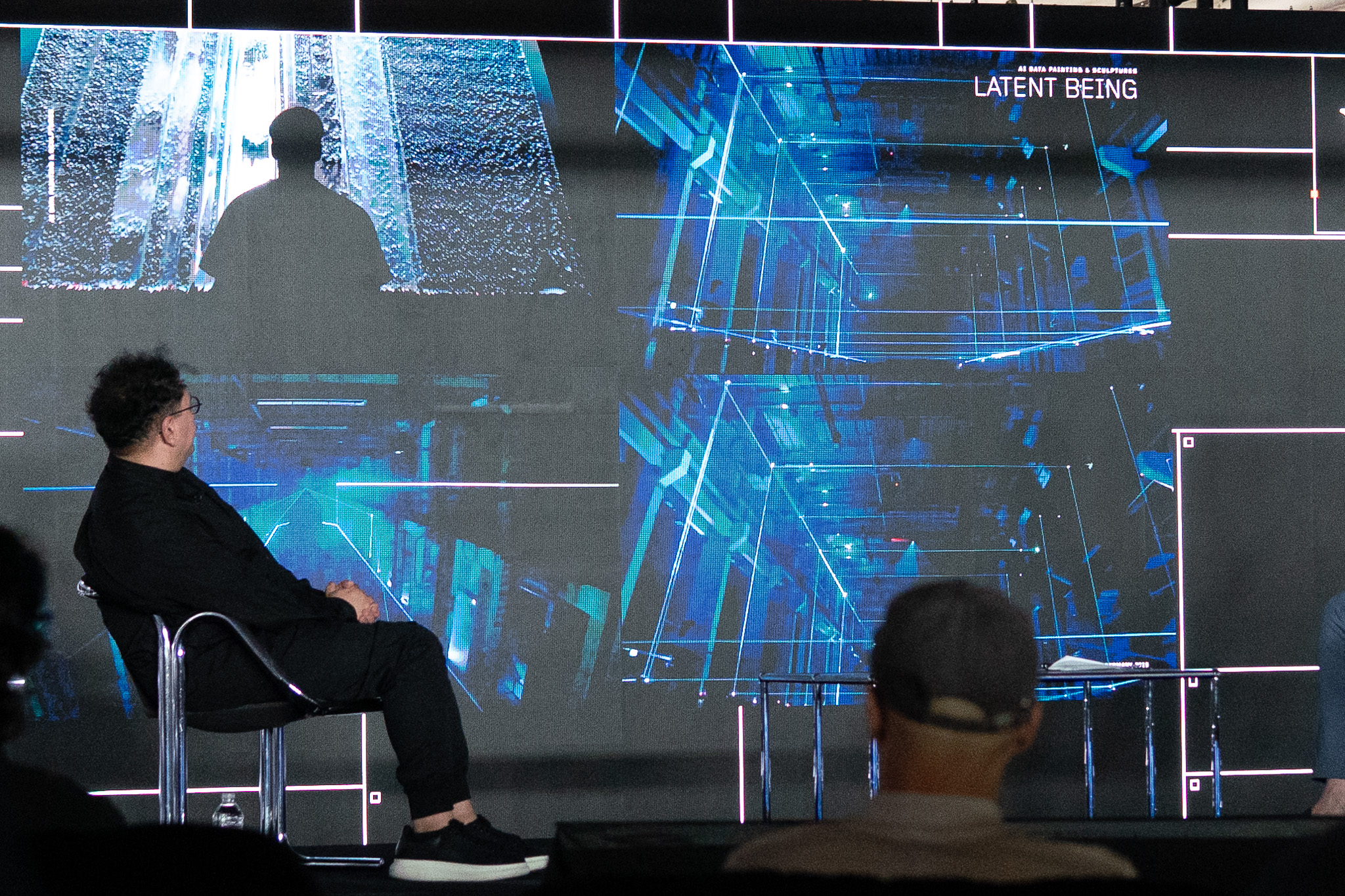
The reviews since have split in a way I find telling. Writing in Artnet, Ann Hirsch called it a take-your-breath-away wonder and the "Citizen Kane" of immersive spaces, landing on a line that stuck with me: the data isn't the content or the form — the data is the paint. LAist's Julia Paskin came away more torn: dazzled, but uneasy about poeticizing AI and about whether a machine-made rainforest can really reconnect us to the real one. Both feel true to what Anadol is reaching for, and the fact that it splits people that cleanly is part of what makes it worth arguing about. (Read both: Artnet and LAist.)
Kim Gu-rin, remaking The Matrix and walkable worlds — without coding.
If the other speakers were seasoned pros, Kim Gu-rin's session was the proof of the page's opening promise: that this is as broad as anyone with an idea. A motion graphics designer by trade — a decade of video work, an AI YouTube channel past a hundred thousand subscribers, and now a contractor at Apple — he put himself "somewhere between non-developer and developer, closer to the non-developer end." And in a single month, using Replit and a couple of other tools, he shipped five working web services without writing code.
By this year his builds had gotten bolder. He'd recreated favorite scenes from The Matrix through vibecoding, turned his portfolio into a game-like world you move through — 3D buildings and streets rendered more like a Nintendo game than a website — and made a calendar with a visual street analog you could walk down. The thread running through all of it was the same: making things by describing them, and being genuinely amazed at how fast, and how good, the results came back.
They started, though, as the small, useful kind of thing you build because you needed it yourself. There was a prompt converter for AI image tools, a one-click cross-poster for social platforms, and a to-do app that splits the day into morning/afternoon/evening so more actually gets done (synced to Google Calendar). Then a coffee-and-wine tasting log that grows into a community, and an AI-news site wired up to post and distribute on its own. His framing for the tools was simple — ChatGPT answers you, but Replit acts: you describe what you want, the agent builds it, and you watch and correct it in real time.
His advice was refreshingly grounded. Start with what you need, then notice when it would help others too. Phrase prompts as positive instructions, not "don't do that." Build the core function first, then the design. And connect outside services through APIs — that's where a plain review site becomes one that can also coach you through a bad shot of espresso. But the reason he stays on Replit isn't a feature; it's the community. He compared it to the Cinema 4D user group that once reshaped his whole field, and closed on what he calls his "thread theory": pull one thread up and the ones around it rise too — when someone succeeds, the people near them tend to succeed as well.
Start with what you need. Then notice who else needs it.
The work happened in the room, out loud.
The part of Walker's account I keep returning to was the process: people in rooms looking at the work, commenting, making changes and enhancements on the fly, problem-solving to find the workarounds. This wasn't about people stuck behind screens making things for screens on their own. It came back, again and again, to working together — and in many cases the result was art for the physical world, inspired and informed by it.
The tools don't matter. What matters is the story, and the emotion it brings about.
We aren't all the way there — but we're getting close.
Walker was honest about the limits, too. There are still things stopping us from making a full feature with AI and code. We aren't quite there. But we're getting a lot closer — and the implication is hard to ignore: projects that used to cost $500k might soon be made for $50k, or $20k. When the price of making something falls that far, the question stops being who can afford to make it and becomes who has something worth making.
The problem was never the AI. It was the picture we had of it.
Part of why AI and creativity sit so uneasily together is the image we carry of it: a cold, solo, button-pressing pursuit, where anyone with zero skill churns out endless slop. VibeCon was the counter-argument in a room. Almost nothing here was solitary or cold — it was hands-on, collaborative, physical, and led by artists. Walker said the skeptics convert once they feel the tools in their own hands. That, more than any demo, is the shape of what's coming: as more artists flip from resisting AI to embracing it, the quality rises with them.
Two things did most of the convincing. The first was physical: so much of this work was made to be seen off our screens, in a room, with other people — the robots drawing on a wall, the scent you wore, the city built by the crowd. Pulling the work into a shared physical space gives it a dimension and a connection that a feed can't. The second was clarity about authorship. What Walker and GMUNK explained so well is that the best work is a human endeavor: people and machines iterating together, brainstorming, experimenting — but with the human driving and building, not the machine deciding. The more openly that division of labor is shown, the harder it is to dismiss the result as talentless button-pressing or "the machine made it."
It's also worth being honest about where we are. Right now we mostly judge this work against the analogs we already know — the video-game look, movie CGI, post-production polish — and a lot of the energy goes into proving we can recreate what already exists. That's the phase we're in. The more interesting question is the one just ahead: not what can we copy, but what can we make that couldn't exist before.
If there's a single thing VibeCon clarified for me, it's this: the more you understand what's happening under the hood — how the artist and the AI actually divide the work, who's doing what — the more transparent the process becomes, and the less there is to be skeptical of. The slop is real, but it's the floor, not the ceiling. This world is accelerating fast. The work on this floor was a glimpse of the ceiling.
The slop is the floor. This was the ceiling.
I kept thinking of David Hockney, who died the week before all this, at 88. He spent seven decades reaching for whatever new tool was at hand — Polaroid grids, the fax machine, and late in life the iPad, which he used to paint a ninety-metre frieze of the Normandy seasons. He embraced each new instrument not to replace his eye but to extend it. So I can't help wondering: if Hockney were twenty years younger, how would he have taken up AI? I suspect he'd have flipped to embrace it without hesitation, and shown the rest of us what it's actually for.
I have to confess — I didn't attend every session, or fully attend every session.